
We’re going to start this one off by hitting you with some facts. Because we have an ulterior motive (to prove to you that joining the shared closet is better for your wallet, and the environment, and your peace of mind).
TL;DR
When it comes to online shopping…
- Around 1 in 4 online clothing orders gets returned. In parts of the EU, it's closer to 1 in 2.
- 63% of online shoppers admit to "bracketing" (ordering multiple sizes on purpose to keep one and send back the rest)
And in general (not specific to online shopping but explains a lot)...
- There's no universal sizing standard for women's clothing. Nor for men’s clothing, but Demat is a shared closet for women so not really relevant here.
time to get real
In the past 12 months…
- How many things have you ordered online? (clothes, shoes, etc.)
- How many things didn’t fit or weren’t your style?
- How many items did you return?
- How many did you mean to return, but you missed the window, or you got busy, or the package just became part of the hallway furniture? (no judgment, we’ve all been there)
- How many times have you ordered the same item in multiple sizes just to be safe?
- How many times have you kept all the sizes because returning was too much effort?
- How many times have you ordered something in your usual size only to find that it’s way too big or way too small upon arrival?
If your numbers are high, congrats! You're the average woman shopping online in 2026.
it’s not you, it’s the system
Or rather, the lack of one.
It's pretty much impossible to know what's going to fit you anymore. It's hard enough when you're buying new—and somehow even worse when you're buying secondhand, where you're not just guessing your current size, you're guessing what your size was the year the piece was made.
For perspective: a women’s size US 14 in 1937 was equivalent to a size US 8 in 1967, which was a size US 0 in 2011 (roughly EU 44 → EU 32).
So it's not surprising that 63% of online shoppers admit to "bracketing," or ordering multiple sizes of the same item on purpose, fully intending to send most of them back. You can't try anything on. Of course you end up sending things back on occasion (or, let's be honest, on most occasions).
A couple of related and not-so-fun facts:
- More than half of all dresses bought online in Europe get returned.
- Ordering multiple sizes is the default behavior for 50% of Gen Z shoppers.
A fun fact about Demat:
- All of the pieces in our shared closet are unique, so it’s not possible to order multiple sizes of the same item. See for yourself.
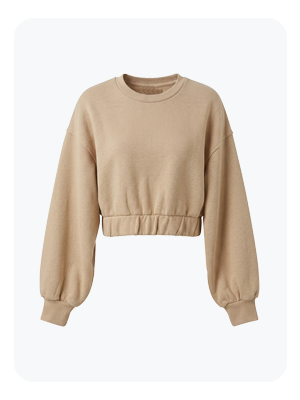
Okay so there are a few things that we do have in multiple sizes but this is a total coincidence!! Like this cropped sweater, the same one donated by two different women in two different sizes:
we never really know if it’s going to fit
One of the most common questions we get from women debating if they want to join the shared closet is: but what if I borrow something and it doesn't fit?
To be fair, this question only comes from women living outside of Den Bosch. Locals just come to the showroom to try things on before renting, so it’s a non-issue.
But I love this question because it accidentally describes online shopping in general. What if you buy something and it doesn’t fit?
The point is: you never really know if what you order online is going to fit (with some exceptions, of course). So whether it’s buying from an e-commerce site or borrowing from the shared closet, you're taking a risk either way. Except with traditional e-commerce, you’ve already paid for the items you’ve ordered. And when they don’t fit, it's now your problem to package, label, and ship everything back within 30 days.
When something you’ve borrowed from the shared closet doesn't fit, it’s of course sad because it’s something you wanted to wear, but you didn't actually buy it. Sure, you’ve paid your monthly membership fee, but even our most expensive membership that includes two shipments per month is almost certainly less expensive than ordering the same thing in multiple sizes (especially if you don’t return the items that don’t fit).
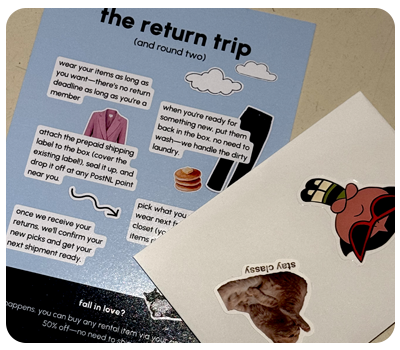
Plus we make it easy for you. There’s no return deadline as long as you're a member, and everything you need to send your pieces back are already in your possession (no trying to find a working printer to print the return label).
long story short
Online shopping is a guessing game. The shared closet is the same game but with a lower price point and a lower environmental impact. We can't fix the fashion industry's sizing chaos, but we can give you a way to stop personally subsidizing it with your forgotten returns.
---------
frequently asked questions
What if I borrow something and it doesn't fit? Send it back with your other return items and pick something else for your next shipment. And make sure to read the item description before borrowing. If there’s something noteworthy about the fit (e.g., runs small), we try our best to document that to aid in your decision making.
Is Demat actually cheaper than buying clothes online? Almost always, yes. Especially if you’re constantly buying multiple sizes. Our memberships start at €25/mo for Den Bosch locals and €55/mo if you want us to ship to you. You can see all our membership options here.
Can I try things on before I borrow? If you’re local to Den Bosch, you can always come to the showroom during our opening hours to try things on before you take them home with you. If you’re a shipping member, you’re welcome to come to our showroom, but we understand that that’s not always possible. So if you receive items in your shipment that don’t fit, that’s unfortunately just a possible consequence of online shopping. But if you receive a shipment and none of your selected items fit, that really sucks, so please get in touch with us.
What about pieces I love? Can I keep them? Yes. Members can buy any of their current rentals at a significant discount (50% off the sale price, to be exact).
Why is this better for the planet than online shopping? Because every piece in our closet is secondhand. Nothing was produced for you. When you buy new clothes online, your purchase becomes a data point retailers use to forecast and produce more. Borrowing from a shared closet doesn't feed that loop. The clothes are already in the world; we just rotate who's wearing them.